
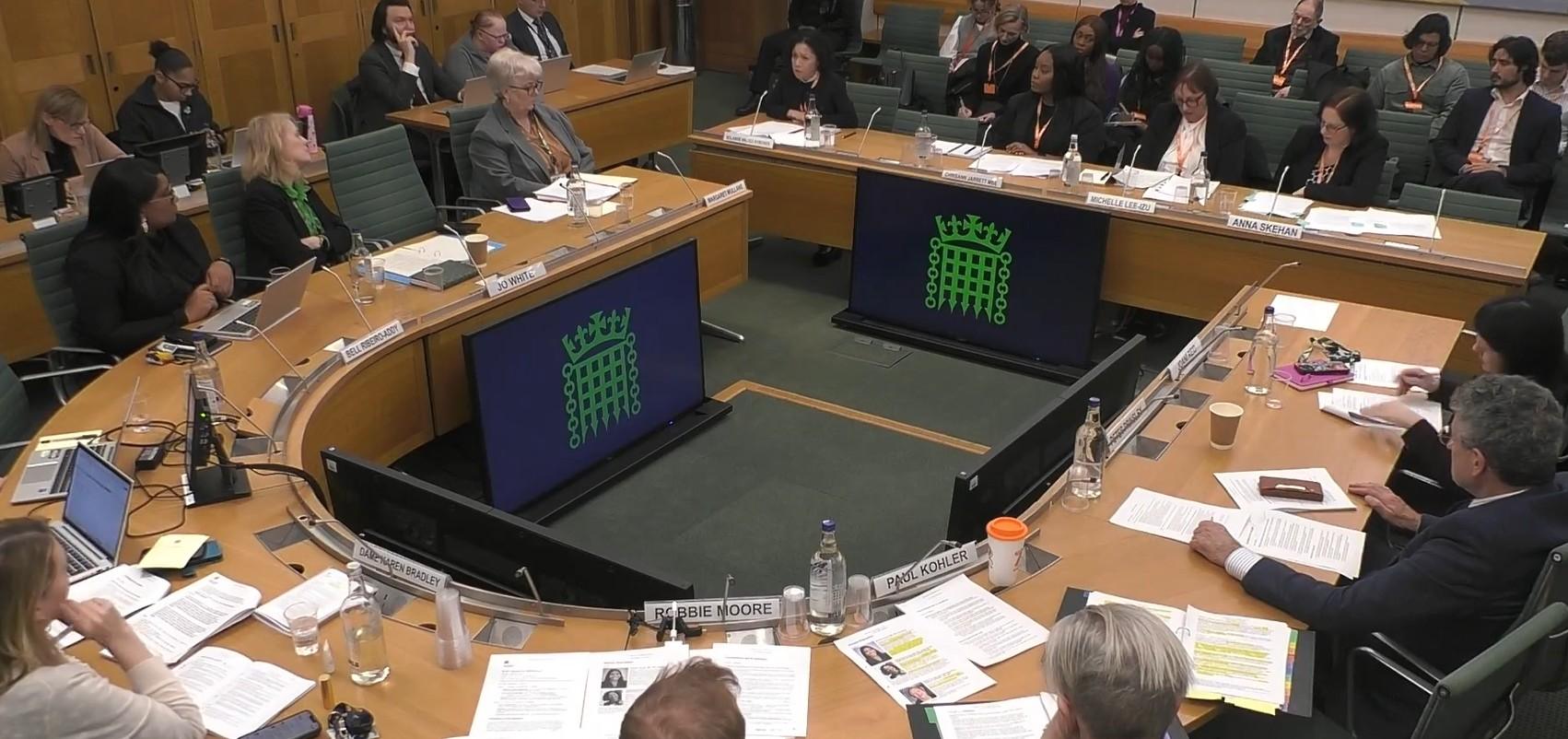
 MiCLU’s legal practice lead Anna Skehan was among witnesses recently providing evidence to the Home Affairs Committee about the impact that proposed changes to routes to settlement (permanent permission to stay in the UK) may have on children.
MiCLU and colleagues at Islington Law Centre have considerable experience and expertise in working with those currently on a 10 Year Route to Settlement. This informed and underpinned the oral and written evidence given to the Committee.
Current settlement routes for children are already lengthy, punitive and costly, as well as structurally ill-suited to childhood, Anna explained at the session in February. The government’s proposed changes – to extend these routes to 15-30 years before individuals would have the right to permanently stay in the UK – would only multiply the existing problems, she said.
“Children are almost an afterthought in their own lives in these applications that are of fundamental importance to them.”
For many children, particularly those on the current 10-year route to settlement, lawful residence depends on navigating complex online forms, making repeat applications with high fees, and adhering to rigid rules where even minor errors can result in time accrued on a route to settlement being set back to zero – all while the availability of legal advice diminishes daily.
Anna identified three core impacts of the current 10-year route: poverty; “de-integration” from peers – whereby a child becomes aware that they are treated differently; and the constant risk of becoming undocumented.
The consequences outlined are serious. For example, families must save thousands of pounds every two and a half years for renewals, often choosing between basic needs and immigration fees. With such high fees out of the reach of many, parents may be forced to prioritise their own applications so they can keep working to support the family – leaving children at risk of falling out of status.
Psychological consequences are particularly severe: Anna described children experiencing distress and anxiety linked to fears of refusal or removal, including one British child who developed stress-related vomiting because she feared her mother and sibling’s applications might fail.
“At whichever point in the process they discover that they do not have an immigration status that matches their peers, it causes them significant worry and distress.”
Anna explained that the system needs to be simplified, fees reduced, and routes designed around children’s circumstances rather than adult-centred immigration frameworks.
Yet the government’s new ‘earned settlement’ proposals are set to increase the baseline to qualify for settlement from 5 years to 10 years for most routes, for individuals who access public funds by an additional 10 years, and for individuals who entered illegally or overstayed, up to 30 years until settlement. This will potentially penalise children and young people for actions over which they have or had no control.
In evidence given by Chrisann Jarrett, CEO of We Belong, up to 330,000 children with precarious status in the UK could be impacted by the new proposals.
“It feels like you have tied a sack of rocks to someone and they are trying to drag those rocks along with them for a decade, or now for 15 years.”
Extending routes to 15, 20 or even 30 years, Anna warned, would only increase the number of people who become undocumented. It would also deepen poverty, and blight more years of childhood and young adulthood.
Children would be forced to relive the trauma and uncertainty of the application process every two and a half years continuing into adulthood – and potentially their own children’s childhood.
Further government proposals to attach “no recourse to public funds” conditions to permanent leave to remain would moreover undermine the very meaning of settlement:
“What is the point of settlement if it does not represent safety and stability and parity with other people who are settled and belong in the UK?”
How could such a system operate fairly, especially for children whose long-term futures are clearly in the UK? Anna questioned, highlighting the risks of retrospective changes shifting fundamental goalposts after families have already invested years and thousands of pounds in a promised route to settlement.
At the heart of the evidence heard by the committee was a simple principle: routes to settlement should reflect children’s age, their residence and their deep connection to the UK.
And rather than extending settlement routes for children and young people, the government should extend the availability of a five-year route to settlement for those who arrived as children, without the need to re-apply halfway through.
“Allowing young people to settle at an early stage offers positive outcomes and makes them more able to achieve their potential. That can only be in the public interest. I do not understand why you would not want that to happen for young people.”
The committee listened carefully to all the experts providing evidence and made clear recommendations in its final report, published on 13 March, including that:
- “People should not be placed on a 30-year route to settlement.” [99]
- “The Government should ensure that all children who come to the UK at a young age and grow up in the UK are granted settled status by the age of 18.” [106]
- “The Government should also maintain the 5-year private life route for children and young people who have lived in the UK for most of their lives, as a backstop and for where this would be a faster route to settlement than granting it at 18.” [106]
- “To reduce the financial pressures associated with repeat applications, and the risk of people losing status, the Home Office should increase the duration of leave to remain on the family or private life route from 2.5 to 5 years.” [99]
- The Home Office should also “set visa fees for people granted leave on the basis of their family and private life at no higher than the cost of administration.” [99]
The committee further recommended that the government both conduct and publish an assessment of the impact that its planned changes to routes to settlement will have on child poverty, before finalising and implementing the proposed changes.
To view the full committee session click here.
For a full transcript of the session click here.
For the Committee Report click here.